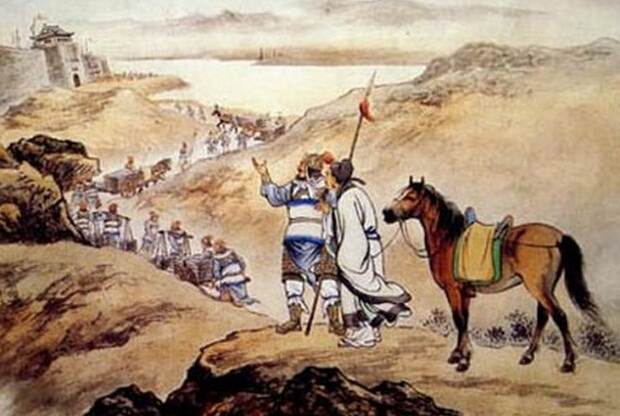
Loulan was an ancient kingdom in the Western Regions, located on the northwest shore of Lop Nur lake in present-day Xinjiang, China. Before the reign of Emperor Zhao of the Western Han (77 BCE), “Loulan” mostly referred to the Kingdom of Loulan. After Emperor Zhao’s reign, the kingdom was renamed Shanshan or the Kingdom of Shanshan, while “Loulan” specifically referred to the city of Loulan, which is today also called the Ruins of Loulan.
Introduction to the poet:
Wang Changling (698–757), courtesy name Shaobo, was a native of Jingzhao Chang’an (present-day Xi’an, Shaanxi Province). He was a frontier poet and statesman of the High Tang period. In the 15th year of the Kaiyuan reign (727), Wang passed the imperial examinations with the jinshi degree and was appointed Proofreader in the Secretariat. In the 22nd year of Kaiyuan (734), he again succeeded in the Boxue Hongci examination and was appointed Assistant Magistrate of Sishui County (present-day Sishui Town, Xingyang, Henan Province). In the 27th year of Kaiyuan (739), he was demoted to Lingnan in Southern China due to an incident. The following year, he returned north to Chang’an from Lingnan and was appointed Assistant Magistrate of Jiangning County (present-day Nanjing, Jiangsu Province). After serving in Jiangning for several years, he again fell victim to slander and was demoted to Assistant Magistrate of Longbiao County (present-day Qianyang, Hunan Province). When the An Lushan–Shi Siming Rebellion broke out, Wang left his place of exile for Jiangning, but was later killed by Lü Qiuxiao, the Prefect of Haozhou.
Wang Changling’s poetry is grand and expansive, forming a style of its own. Ming critic Wang Shizhen, when discussing the great seven-character quatrains of the High Tang, considered only Wang Changling a match for Li Bai, ranking him among the “divine.” Wang composed a large number of frontier poems, filled with heroic passion, powerful momentum, and lofty style, which earned him recognition as the founder and pioneer of frontier poetry. He was praised as “The Master of Poetry, Wang of Jiangning” and later honored as the “Sage of the Seven-Character Quatrain.” His poetic thought is both dense and lucid, placing him alongside Gao Shi and Wang Zhihuan. He left behind six volumes of collected works and four volumes of poetry. His major representative works include "From Army Life (Cong Jun Xing)", "Beyond the Frontier (Chu Sai)", and "Lament in the Boudoir (Gui Yuan)".










.jpg)
