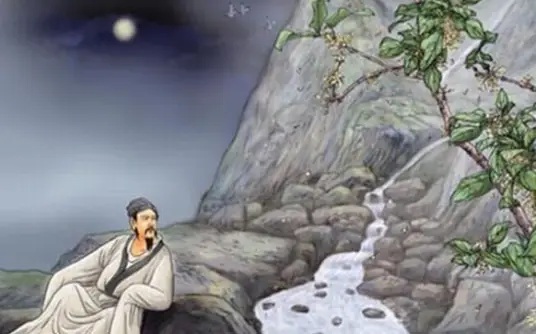
Spring hills abound in splendid sights,
In joy and play I forget to return at night.
Scooping water, the moon rests in my hand;
Cressing flowers, their fragrance clings to my robe.
When delight stirs, distance matters not;
As I leave, I grieve to part with the charming blossoms.
Southward I gaze where temple bells resound,
Pavilions and towers steeped in deep verdant mist.
 【詩人簡介】于良史(生卒不詳) ,唐代诗人,肃宗至德年间曾任侍御史,代宗大历年间任监察御史。德宗贞元年间,徐州、泗州节度使张建封辟为从事。其五言诗词语清丽超逸,讲究对仗,十分工整。诗甚为清雅,多写景,构思巧妙,形象逼真,同时寄寓思乡和隐逸之情。诗风与"大历十才子"相近。今仅存诗七首,都是佳作,尤以 《春山夜月》、《宿蓝田山口奉寄沈员外》两首为最善。《春山夜月》中“掬水月在手,弄花香满衣”是很有名的佳句。明代胡应麟曾在《诗薮》称其《冬日野望寄李赞府》中“风兼残雪起,河带断冰流”二句“形容景物,妙绝千古”是盛中晚唐诗歌界限的标志。
其诗入《中兴间气集》,《全唐诗》有录。
【詩人簡介】于良史(生卒不詳) ,唐代诗人,肃宗至德年间曾任侍御史,代宗大历年间任监察御史。德宗贞元年间,徐州、泗州节度使张建封辟为从事。其五言诗词语清丽超逸,讲究对仗,十分工整。诗甚为清雅,多写景,构思巧妙,形象逼真,同时寄寓思乡和隐逸之情。诗风与"大历十才子"相近。今仅存诗七首,都是佳作,尤以 《春山夜月》、《宿蓝田山口奉寄沈员外》两首为最善。《春山夜月》中“掬水月在手,弄花香满衣”是很有名的佳句。明代胡应麟曾在《诗薮》称其《冬日野望寄李赞府》中“风兼残雪起,河带断冰流”二句“形容景物,妙绝千古”是盛中晚唐诗歌界限的标志。
其诗入《中兴间气集》,《全唐诗》有录。
Introduction to the poet:
Yu Liangshi (birth and death dates unknown) was a poet of the Tang dynasty. During the Zhide era of Emperor Suzong, he served as Shiyushi (Censorate Attendant), and in the Dali era of Emperor Daizong, he held the post of Jiancha Yushi (Investigating Censor). In the Zhenyuan era under Emperor Dezong, he was appointed as an aide by Zhang Jianfeng, the Military Commissioner of Xuzhou and Sizhou.
His five-character poems are noted for their limpid elegance and lofty style, with meticulous attention to parallelism and structure. Refined and graceful, his poetry often depicts natural scenery, with ingenious conception and vivid imagery, while conveying sentiments of homesickness and reclusion. His poetic style is akin to that of the “Ten Talents of the Dali Reign.” Only seven of his poems survive today, all of which are fine works, with "Moonlit Spring Mountain" (《春山夜月》) and Lodging at Lantian Pass, Respectfully Sent to Secretary Shen (《宿蓝田山口奉寄沈员外》) being the most outstanding. The lines “Scooping water, the moon rests in my hands; cressing flowers, fragrance clings to my robe” from "Moonlit Spring Mountain" are particularly celebrated.
During the Ming dynasty, Hu Yinglin, in his Shisou (Anthology of Poetry), praised the couplet “The wind rises with lingering snow; the river flows bearing broken ice” from "Winter Day in the Wilds, Sent to Prefect Li" (《冬日野望寄李赞府》), calling it a matchless depiction of scenery “unparalleled through the ages,” and a hallmark of the transition in Tang poetry from the High to the Middle and Late periods. His works were included in the 《Anthology of the Spirit of the Restoration》 (《中兴间气集》) and are recorded in the 《Complete Tang Poems》 (《全唐诗》).










.jpg)
