Adieus to My Wife
- two poems
by Liao Zhongkai
(Written in 1922)
I
I leave to you alone our missions after my death,
Fail not the name of heroine true and worthy.
My spirit remains though the body departs,
Better than a butcher’s knife gripped but in vain.
II
Life's not so admirable, death won't be so sorrowful,
Life and death rotating in the cosmos.
After forty-five years of worldly suffering,
Once extricated I'll gain insight into my past errors.
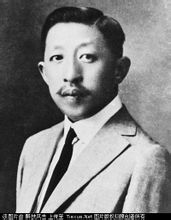 【诗人简介】 【诗人简介】
廖仲恺(1877年—1925年),广东省归善县(今广东省惠阳市)人,出生于美国旧金山,国民党左派的光辉旗帜, 擅长诗词、书法。1893年回国,1896年入香港皇仁书院学习。1903年1月赴日本留学,3月入早稻田大学预科政治科,同年结识民主革命先行者孙中山。1905年加入同盟会,任同盟会总部外务部副部长、会计长。1906年,翻译了一些早期社会主义学说,并在同盟会机关报《民报》上发表。辛亥革命后任广东军政府财政部副部长,1912年5月升任军政府财政司司长。1913年8月, “二次革命”失败后,与孙中山等流亡日本。1914年5月加入中华革命党(孙中山在原国民党基础上重组),1915年任中华革命党财政部副部长,继续为讨袁筹措军费。1917年9月任中华民国护法军政府财政次长、代理总长。1918年6月随孙中山到上海后,和朱执信创办《建设》杂志,宣传和研究革命理论。1921年5月,广东革命政府成立,任财政部次长。积极筹款支持孙中山的北伐计划,遭到反对北伐的粤军总司令陈炯明的囚禁,经夫人何香凝等人的积极营救获释。此后,全力辅佐孙中山改组国民党,并极力促成第一次国共合作; 是孙中山 “联俄、联共、扶助农工”三大政策的忠实执行者和捍卫者。1924年1月任海陆军大元帅大本营秘书长、国民党一大中央执行委员、中央常委、工人部长,并积极筹备建立黄埔军校,任党代表。11月任中央农民部长。在平定商团叛乱、杨刘叛乱、北伐、东征等战役中起了重要作用,为巩固广东革命政权作出了巨大贡献。1925年7月国民政府成立,任财政部长、军事委员会常务委员、广东省政府财政厅长。1925年8月20日,在设于惠州会馆的国民党中央党部被帝国主义和国民党右派所指使的暴徒杀害,遗体先是暂厝广州驷马岗朱执信墓旁,1935年迁葬南京中山陵侧。今越秀南路89号中华全国总工会旧址,立有纪念碑.
Introduction to the poet: Liao Zhongkai (1877-1925) was born in 1877, in San Francisco, United States. His ancestral home was Guishan County (now Huiyang City), Guangdong Province. Liao was the glorious banner of the Kuomintang left wing, proficient in poetry and calligraphy. In 1893, he returned to China and in 1896, he enrolled in the Hong Kong Imperial College for further studies. In January 1903, he went to Japan to study, and in March, he enrolled in the pre-university political science program at Waseda University. That same year, he met Sun Yat-sen, a pioneer of the democratic revolution. In 1905, he joined the Chinese Revolutionary Alliance (Tongmenghui) and served as Deputy Minister of Foreign Affairs and Chief Accountant of the Chinese Revolutionary Alliance Headquarters. In 1906, he translated some early socialist theories and published them in the 《People's Journal》, the organ newspaper of the Chinese Revolutionary Alliance.After the 1911 Revolution, he served as the Deputy Minister of Finance of the Guangdong Military Government and was promoted to the position of Director of the Finance Department of the Military Government in May 1912. In August 1913, after the failure of the Second Revolution, he fled to Japan with Sun Yat-sen and others. In May 1914, he joined the Chinese Revolutionary Party (reorganized by Sun Yat-sen based on the original Kuomintang), and in 1915, he became the Deputy Minister of Finance of the Chinese Revolutionary Party, continuing to raise military funds for the campaign against Yuan. In September 1917, he was appointed as the Deputy Minister of Finance and Acting General of the Republic of China's Protectorate Military Government. After accompanying Sun Yat-sen to Shanghai in June 1918, he founded the magazine 《Construction》 with Zhu Zhixin to promote and study revolutionary theories. In May 1921, the Guangdong Revolutionary Government was established and appointed Liao as the Deputy Minister of Finance. Actively raising funds to support Sun Yat-sen's Northern Expedition plan, Liao was imprisoned by Chen Jiongming, the commander-in-chief of the Guangdong Army, who opposed the Northern Expedition. With the active rescue by his wife, He Xiangning and others, he was released. Afterwards, he fully assisted Sun Yat-sen in reorganizing the Kuomintang and made every effort to promote the first cooperation between the Kuomintang and the Communist Party. He was a loyal executor and defender of Sun Yat-sen's three major policies of "uniting with Russia, uniting with the Communist Party, and assisting the peasants and workers".In January 1924, he was appointed as the Secretary General of the Navy and Army Marshal Headquarters, a member of the Central Executive Committee and Standing Committee of the First National Congress of the Kuomintang, and the Minister of Workers. He actively prepared for the establishment of the Huangpu Military Academy and served as a party representative. In November, he served as the central farmer minister. He played an important role in suppressing the rebellion of the merchant group, the Yang Liu rebellion, in the Northern Expedition, the Eastern Expedition, and other battles, making great contributions to consolidating the revolutionary government in Guangdong. In July 1925, the Nationalist Government was established, and he was appointed as the Minister of Finance, Executive Member of the Military Commission, and Director of Finance of the Guangdong Provincial Government. On August 20, 1925, at the Kuomintang Central Party Headquarters located in Huizhou Guild Hall in Guangzhou he was killed by thugs instigated by imperialism and the right-wing of the Kuomintang. His body was temporarily buried next to the tomb of Zhu Zhixin in Simagang, Guangzhou, and was relocated to the side of Zhongshan Mausoleum in Nanjing in 1935. A monument in his honor is in the former site of the All-China Federation of Trade Unions at No. 89 Yuexiu South Road in Guangzhou.
|