|
【註】諸葛亮《教子書》(也常叫“誡子書”)是諸葛亮寫給兒子諸葛瞻的一篇家訓短文,全篇只有八十餘字,但語意深遠。最早見於 《諸葛亮集》,後來收入《古文觀止》等書,被廣為傳誦。
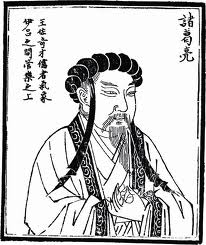
【詩人簡介】诸葛亮(181年—234年10月8日),字孔明,号卧龙,琅琊阳都(今山东省沂南县)人 ,三国时期蜀汉丞相,中国古代杰出的政治家、军事家、战略家 、发明家、文学家。
诸葛亮早年随叔父诸葛玄到荆州,诸葛玄死后,诸葛亮躬耕于南阳。 刘备依附荆州刘表时三顾茅庐,诸葛亮向刘备提出占据荆州、益州,联合孙权共同对抗曹操的《隆中对》,刘备根据诸葛亮的策略,成功占领荆州、益州之地,与孙权、曹操形成三足鼎立之势。章武元年(221年),刘备称帝,任命诸葛亮为丞相。刘备伐吴于夷陵之战失败后,刘备于永安托孤于诸葛亮。刘禅继位后,封诸葛亮为武乡侯,领益州牧。诸葛亮勤勉谨慎,大小政事必亲自处理,赏罚严明;与东吴联盟,改善和西南各族的关系;实行屯田政策,加强战备。诸葛亮前后五次北伐中原,但未能实现兴复汉室的目标。终因积劳成疾,于建兴十二年(234年)病逝于五丈原(今陕西省宝鸡市岐山境内),享年五十四岁 。后主刘禅追谥为忠武侯,后世常以“武侯”尊称。东晋桓温追封为“武兴王”。
诸葛亮散文代表作有《出师表》《教子书》等。曾发明木牛流马、孔明灯等,并改造连弩,人稱诸葛连弩,可一弩十矢俱发。 诸葛亮一生“鞠躬尽瘁,死而后已”,是中国传统文化中“忠臣”与“智者”的代表人物。
Note : Zhuge Liang’s "Admonition Letter to His Son" is a short piece of family instruction written to his son Zhuge Zhan. Though consisting of only a little over eighty characters, its meaning is profound. It first appeared in the 《Collected Works of Zhuge Liang》 and was later included in anthologies such as 《Selections of Refined Literature》 (Guwen Guanzhi), through which it became widely known.
Introduction to the poet:
Zhuge Liang (181 – October 8, 234), courtesy name Kongming, style name Wolong (“Crouching Dragon”), was a native of Langya Yangdu (present-day Yinan County, Shandong Province). He served as Chancellor of Shu-Han during the Three Kingdoms period and was one of ancient China’s most outstanding statesmen, military strategists, inventors, and man of letters.
In his youth, Zhuge Liang followed his uncle Zhuge Xuan to Jingzhou. After his uncle’s death, he lived in seclusion, farming in Nanyang. When Liu Bei sought refuge with Liu Biao in Jingzhou, he famously visited Zhuge Liang’s thatched cottage three times. Zhuge Liang then presented to Liu Bei the “Longzhong Plan”, proposing that Liu should seize Jingzhou and Yizhou, and ally with Sun Quan to resist Cao Cao. Guided by this strategy, Liu Bei successfully occupied Jingzhou and Yizhou, forming a three-way balance of power with Sun Quan and Cao Cao.
In the first year of Zhangwu (221), Liu Bei proclaimed himself emperor and appointed Zhuge Liang as Chancellor. After Liu Bei’s defeat in the Battle of Yiling during his campaign against Eastern Wu, he entrusted his heir to Zhuge Liang at Yong’an. Upon Liu Chan’s accession, Zhuge Liang was enfeoffed as Marquis of Wuxiang and made Governor of Yizhou.
As administrator, Zhuge Liang was diligent and cautious, personally handling all major and minor affairs, administering rewards and punishments with strict fairness. He maintained the alliance with Eastern Wu, improved relations with the southwestern peoples, implemented the system of military farming, and strengthened defenses. He launched five northern expeditions to the Central Plains in an effort to restore the Han dynasty, but failed to achieve that goal. Exhausted by overwork, he fell ill and died in the twelfth year of Jianxing (234) at Wuzhang Plains (in present-day Qishan County, Baoji, Shaanxi Province), at the age of fifty-four.
After his death, Emperor Liu Chan granted him the posthumous title Marquis Zhongwu. Later generations often respectfully referred to him simply as “Marquis Wu.” In the Eastern Jin, Huan Wen posthumously honored him as King Wuxing.
Zhuge Liang’s representative prose works include "The Memorial on Sending Forth the Army" (Chushi Biao) and "The Admonition Letter to My Son" (Jiaozishu). He is credited with inventing the wooden ox and flowing horse (transport devices), the Kongming lantern, and improving the repeating crossbow, later known as the “Zhuge Crossbow,” capable of discharging ten bolts at once.
Zhuge Liang devoted his entire life to tireless service—“to bend to his work with utmost effort until death”—and became in Chinese tradition a model of both the loyal minister and the wise statesman. |