Mourning for Zhongkai
by He Xiangning
(Written in 1925)
Tossing alone on the orchid bed, clutching the quilt,
I rise to read once more the Song of the Cypress Boat.
Where can we meet in the frosty night and bright moonlight?
My shadow dims by the dying lamp as the night deepens.
I know how rare that is to meet you in dreams,
No art can call your soul back, grief is hard to restrain.
My mourning thoughts turn only to fulfilling your vows,
Not knowing when it be realized to devote all to the nation.
【注】
- 兰床:旧时对妇女床榻的美称。
- 柏舟:《诗经》的“墉风”篇的“柏舟”一诗表示女子对爱人的感情深厚、贞挚,誓死不变。
- 廖仲恺的《留诀内子(二首)》诗有句 “后事凭君独任劳,莫教辜负女中豪”,诗人在这里回应廖仲恺的遗嘱。
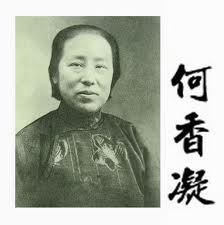
【诗人简介】 何香凝(一八七八——一九七二年),原名谏,广东南海县人,是中国民主革命时期的杰出的女革命家。她早年在日本随同孙中山先生从事民族民主革命,是孙中山亲自发展的第一批同盟会会员,是孙中山的战友廖仲恺的夫人。辛亥革命后,积极参加反袁和护法运动。坚决支持孙中山的新三民主义革命纲领。她是诗人,同时也是著名的画家。一九〇八年入东京本乡女子美术学校求学。一九二九年到巴黎,三十年代初回国,投身于抗日救亡运动。一九三八年迁居香港。她一生勤奋作画,作品有一千余幅。何香凝老人在中华人民共和国成立后,先后担任华侨事务委员会主任,中国国民党革命委员会主席,人大常委会副委员长,并担任过中国美术家协会主席。一九七二年病逝北京。著有《何香凝画集》。
Notes:
- Orchid bed: a graceful name for women's beds in ancient times.
- In the chapter " Fu Feng” of the 《Book of Songs》, there is a poem titled "Baizhou" indicating that a woman's feelings for her lover are deep and sincere, and she vows to die unchanged.
- In Liao Zhongkai's poem "Adieus to My Wife (Two Poems)", there are lines: "I leave to you alone our missions after my death, Fail not the name of heroine true and worthy." The poet here responds to her husband's will.
Introduction to the poet: He Xiangning (1878-1972), originally named Jian, from Nanhai County, Guangdong Province, was an outstanding female revolutionary during the period of China's democratic revolution. In her early years, she was engaged in the national democratic revolution with Dr. Sun Yat-sen in Japan. She was one of the first members of the Chinese Revolutionary Alliance recruited by Dr. Sun Yat-sen himself and she was the wife of Liao Zhongkai, Sun Yat-sen's comrade-in-arms. After the 1911 Revolution, she actively participated in the anti-Yuan and law-protection movements. She firmly supported Sun Yat-sen's revolutionary program of the New Three People's Principles. He Xiangning was a poet and a famous painter. In 1908, she enrolled in the Tokyo Honjo Women's Art School. She went to Paris in 1929, returned to China in the early 1930s, and devoted herself to the Anti-Japanese salvation movement. In 1938, she moved to Hong Kong. She worked diligently in painting throughout her life, with over a thousand works. After the establishment of the People's Republic of China, He Xiangning served as the Chairman of the Overseas Chinese Affairs Committee, the Chairman of the Revolutionary Committee of the Kuomintang, and the Vice Chairman of the Standing Committee of the National People's Congress; she also served as the chairman of the China Artists Association. She passed away in Beijing in 1972. She is the author of 《He Xiangning Paintings Collection》.
|










.jpg)
.jpg)
